Young People Take Action in the Labs


Since December 2025, Youth AI Lab has entered its delivery phase with the young people involved in each lab. Seventeen sessions have been held in La Rochelle, Naples, Barcelona and Antwerp.
The workshops follow different schedules in each location and are adapted to both their audiences and chosen formats. Activities also vary, ranging from observing AI systems and playing games to programming robots, testing tools and creating prototypes.
Despite these differences, all four labs share the same goal: to help young people understand how generative AI works through practical activities and a rigorous scientific approach.
In La Rochelle, understanding AI’s limitations to build reliable chatbots
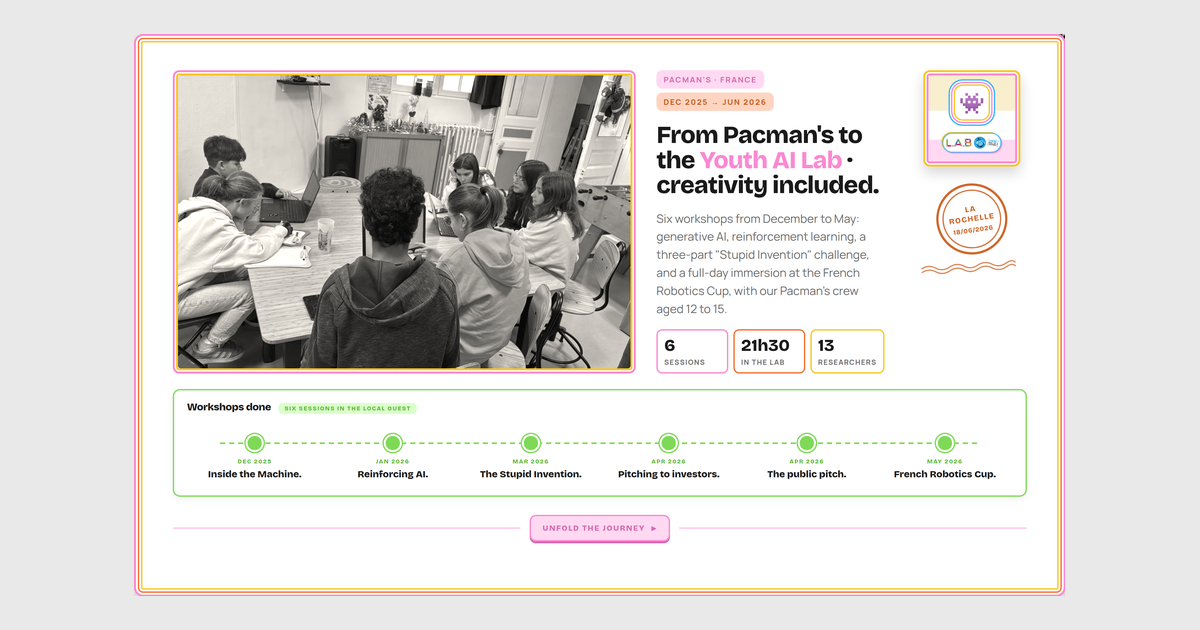
Since December 2025, the Youth AI Lab “Le retour des Pacman’s”, run by the Vent des Îles Social and Cultural Centre and the Laboratoire d’Aix-périmentation de bidouille, has brought together 18 young people aged 12 to 15 for seven sessions—including an intensive week—totalling 38.5 hours.
The programme was built around a simple question: Can we trust an AI-generated answer? The first games showed that a model could accept false information and continue responding as though it were correct. The young participants thus learned that a well-worded answer is not necessarily verified information.
To understand the reason for this gap, the group then explored machine learning. The reinforcement-learning activity was not intended to reproduce how generative AI works. Instead, it illustrated a broader principle: a system’s behaviour depends on how it is trained and the signals it receives. By finding a route and then programming robots, the participants saw that a machine does not independently assess what is true or relevant. It operates within the framework it has been given.
The Stupid Invention sequence returned to generative AI with this new point of reference. This time, the group was no longer simply asked to spot a misleading answer. Instead, they prompted the AI to make deliberately absurd products sound credible. The results showed that credibility also depends on the instructions given to the model and on how text and images are presented.
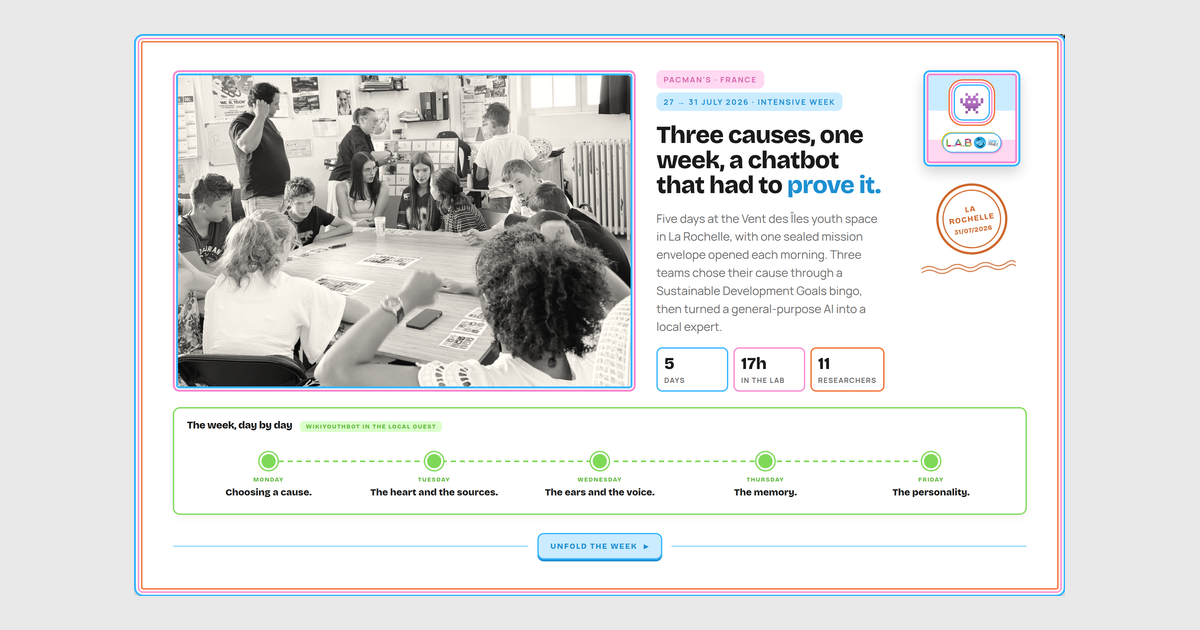
The intensive week in July then reversed the challenge. After seeing how AI could make an invention sound credible, the group had to build tools whose answers would be more carefully controlled. For Feurisson, which focuses on fire prevention, and Superbot, which addresses school bullying, the young participants defined their audiences, selected sources, drafted reference answers and established rules for sensitive situations. Reliability thus became a tangible design choice.
The learning journey therefore follows a consistent thread. The young participants first learned to question a convincing answer, then connected a system’s behaviour with its training and instructions. They used this understanding to produce misleading content before exploring how to place better safeguards around a chatbot’s responses.
Workshops, prototypes and projects produced by the La Rochelle group.
In Naples, understanding data to enable the Otto robot to act
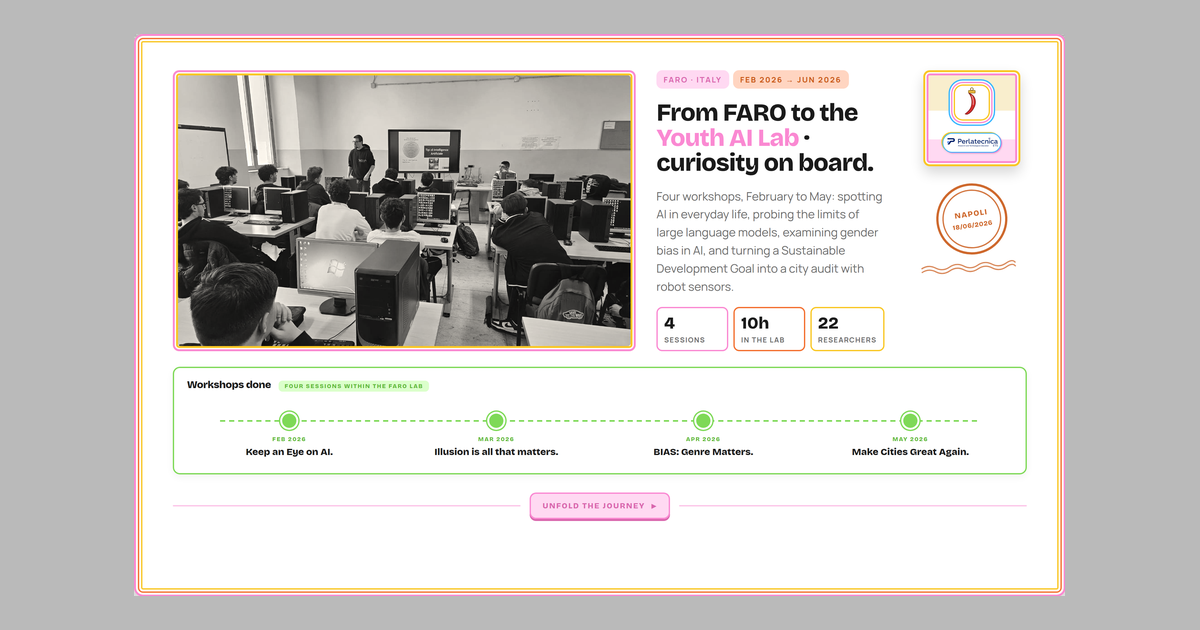
The Youth AI Lab FARO lab, run by Perlatecnica in partnership with the ITIS Alessandro Volta technical high school, worked with young people aged 16 to 17 in four 2.5-hour workshops between February and May 2026.
In Naples, the work began by identifying AI systems present in everyday surroundings, which the young participants distinguished from systems based on fixed rules. This observation gave them a tangible starting point for considering how AI might help address local challenges.
To understand both the potential and limitations of these systems, the group then examined reasoning errors made by language models. Introducing the Otto robot made these questions more concrete. The participants compared running the model locally on the robot with running it in the cloud, taking privacy, speed, battery life and cost into account. They saw that an AI system also depends on technical choices that affect how it can be used.
Work on gender bias extended this reflection. By testing a language model’s responses and then a classification based on height and weight, the group saw how chosen categories shape results and can oversimplify a complex reality. This issue became central when they applied AI to the sustainable city.
Otto was then equipped with sensors to measure carbon dioxide, fine particles and noise. The young participants used a model trained on simulated data and analysed its errors to understand, for example, why a noisy park could be mistaken for a construction site. The model was no longer presented as an automatic solution, but as a tool whose decisions needed to be checked.
Over the course of the sessions, the group’s perspective changed. The goal was no longer simply to identify AI in the city, but to understand the technical choices and categories shaping its results, and then apply that knowledge to a local problem using Otto.
Experiments conducted with the Otto robot at the FARO lab in Naples.
In Barcelona, understanding a model’s errors to build a useful prototype
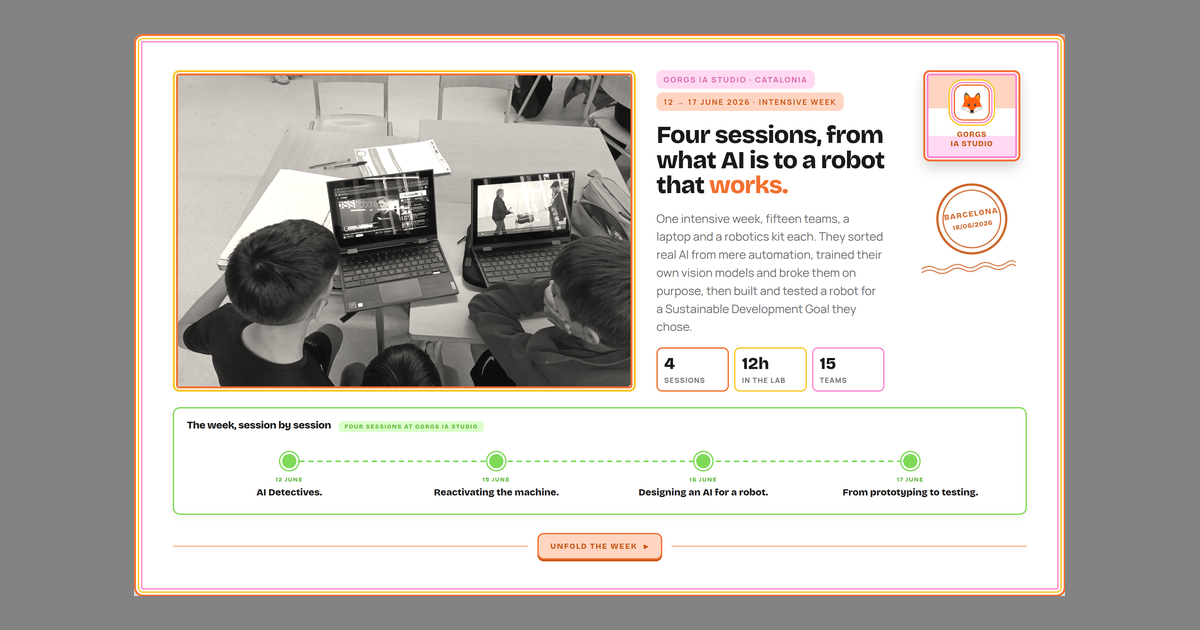
The Youth AI Lab Gorgs IA Studio, run by the Universitat Autònoma de Barcelona and hosted by its School of Engineering, organised four three-hour sessions over the course of one week. Three mentors supported the young participants through this intensive programme.
In Barcelona, the four sessions formed a tightly structured progression. The young participants began by comparing rule-based programming with learning from examples. By training a model to recognise shapes, they saw that its results depended directly on the images used.
The group then deliberately tried to trigger errors by changing the lighting, angle and background. This helped them understand that a model can perform well under expected conditions and fail as soon as the situation changes. Technical and social biases were thus explored through limitations observed during testing.
These findings became the starting point for the projects. Each group chose a problem linked to a Sustainable Development Goal and then clarified the need using an empathy map. The solution had to be useful, feasible and compatible with what the model could realistically learn. The participants then paired the model with a robot to build an initial prototype.
The final step was to have the other groups test the prototype. Expected cases, edge cases and unexpected situations were recorded before the final presentation. Errors therefore did not mark the end of the project; they helped identify what needed to be improved.
In four days, the groups connected how a model works with a specific use case. They learned to test its limitations and account for the results when designing their prototype.
Training, testing and improving the prototypes developed in Barcelona.
In Antwerp, moving from recognition to a group-designed object
The Youth AI Lab run by Digitale Wolven held two separate pilot workshops with five young people in August, totalling four hours. Each workshop tried out different robotics equipment, to see which would appeal most to the target group before the regular programme begins in the autumn.
Both workshops dealt with the same principle, recognition, but on different equipment. In the first, the young participants worked with images captured by an Mbot camera. In the second, they trained a micro:bit with CreateAI to recognise their own movements.
Setting the two workshops side by side highlights what remains constant: examples must be provided, the system must be trained, its recognition must be tested and the result must be used in a programme. The interactive game box created during the second workshop was a first application of this process.
These two workshops do not yet form a complete programme, but they validated both a technical foundation and a way of working.
The learning journeys in pictures
For a more visual look at these journeys, the first postcards live from our labs are now online. They show what the young participants achieved during the first six months of Youth AI Lab delivery and how each group developed its project.
The first four postcards are already available: